
The Old State House
Our offices are located in Rhode Island's Old State House, now a repurposed State building in the heart of Providence's colonial city center.
As stewards of this important historic landmark since the 1970s, the RIHPHC has invested significant resources in restoring the building's historic fabric while accommodating the needs of a 21st-century workspace. In 2015, the Old State House became Rhode Island’s first state-owned property to install a new geothermal heating and cooling system. More recently, exterior work restored the brick masonry and replaced severely deteriorated brownstone features, repaired historic windows, restored the belfry, replicated the historic bell carriage, and replaced the wood shingle roof. These improvements, along with accessibility upgrades underway in 2024-2025, will keep the Old State House in working order as a historic site and preservation headquarters.
A full architectural history is outlined below.
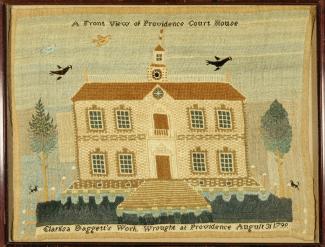
1799: Clarissa Daggett stitched this view of the Providence Court House, now known as the Old State House (courtesy of RISD Museum)

Ca. 1840s: the Old State House before the stair tower was constructed.

n.d. Old State House guarded by Gettysburg and Bull Run cannons (courtesy of State Archives)

1920: A postcard of the Old State House (courtesy of Providence Public Library)

Benefit Street facade (2022)
Architectural History of the Old State House
An architectural landmark in Providence’s College Hill Historic District, the Old State House has played a pivotal role in the political life of Rhode Island since the colonial period. It is one of just six surviving colonial-era state houses in America, three of which are in Rhode Island. The building’s historical development reflects Providence’s growing political prominence and the changing nature of Rhode Island’s state government.
It has been the site of significant political and legislative actions. In this building, Rhode Island renounced allegiance to the British Crown on May 4, 1776, the first of the thirteen colonies to do so. The General Assembly, meeting in the Old State House, repealed restrictions on the voting rights of Roman Catholics in 1783; passed the Gradual Emancipation Act in 1784, one of the first such laws in the United States; and was one of the first state legislatures to abolish the death penalty, in 1852.
Built in 1760-62 and expanded twice in the 19th century, The Old State House is an excellent example of the Georgian style with later alterations that have acquired their own significance. The building is listed individually in the National Register of Historic Places at the national level of significance, in the areas of architecture and politics, and it is a contributing resource in the College Hill National Historic Landmark District and the nationally significant College Hill National Register Historic District.
The Old State House is one of five former Rhode Island state houses, one built in each of the state’s counties to accommodate rotating sessions of the General Assembly. The buildings, sometimes referred to as “colony houses” were also used as courthouses. After Providence’s first colony house burned in 1758, the General Assembly soon ordered the construction of a replacement, to be built on a site commanding the full block between Town Street (now North and South Main Street), which was the principal thoroughfare in the original settlement, and the newly-laid-out Benefit Street. The two-story, rectangular-block, brick building was modeled after the Newport Colony House (1736-39). It had a symmetrical composition; segmental-arch window openings; brownstone quoins, window trim and stringcourse; a second-story balcony; and a balustraded hip roof with a center gable and wood cupola. Its elevated site, approached by an axial parade ground, referenced Baroque planning concepts that had become popular in other colonial cities and enhanced the building’s grandeur.
As originally constructed, the building housed the Chamber of Deputies (later the House of Representatives) and the Governor’s Council Chamber (later the Senate Chamber) on its second floor. The Council Chamber is remarkably intact with fluted Ionic pilasters, a full entablature with modillion cornice, and bolection paneling, a relatively rare surviving example of this mid-18th-century architectural finish in Providence. The first floor, meanwhile, consisted of a large hall for public gatherings. It was here that General George Washington was honored with a dinner and ball in 1781. Washington returned to the Old State House as President in 1790; he and Thomas Jefferson attended a banquet celebrating Rhode Island’s ratification of the U.S. Constitution. In 1824-25, the Revolutionary War hero the Marquis de Lafayette toured the United States and attended a reception at the Old State House. These events demonstrate the centrality of the Old State House to Rhode Island’s civic life in the colonial period and the early years of the new republic.
Over the course of the 19th century, Providence – geographically positioned to take advantage of an industrializing economy – overtook Newport as Rhode Island’s political, financial and civic center. While General Assembly sessions continued to rotate among the five colony houses until 1854, and then alternated between Newport and Providence, by the latter part of the century the Old State House had become Rhode Island’s principal seat of legislative power. The city’s growing primacy, as well as important political developments, influenced the building’s appearance, with renovations and additions designed by some of Rhode Island’s most prominent architects.
An 1840 renovation, attributed to Russell Warren, enlarged the Representatives’ Chamber. A new state constitution in 1842 increased the size of the legislature; consequently, Thomas A. Tefft oversaw a major renovation in 1850-51, reworking the interior spaces and adding a stair tower to the west façade, removing the balcony, cupola and center gable in the process. In 1867, a large mansard-roof wing housing mostly judicial functions was constructed off the building’s east elevation, to plans by James C. Bucklin; the roof on the original block was reconfigured to its current double-hip form in the process. Both additions, constructed of brick with rusticated brownstone trim, harmonized with the original building’s Georgian character. In 1877-83, Stone & Carpenter oversaw work on the interior, which included remodeling as well as the restoration of some earlier architectural features and spaces, notably the former Council Chamber, which had become the Secretary of State’s Office. The architects carved out a small room from the original stair hall to serve as the Governor’s office, indicative of the relative status of that position in 19th-century Rhode Island.
With the opening of a new state house in 1901 (designed by McKim, Mead & White), the Old State House became home to the Sixth District Court, and the building’s last major alteration was executed by Banning & Thornton in 1904-06. The interior, including the new first-floor courtroom in what had originally been a large hall, was refurbished in the Colonial Revival style. Massive wood-encased steel girders were installed in the courtroom and detailed with classically inspired scrolled brackets; the ceiling received a robust modillion cornice; Colonial-style molded window and door trim was added; and combination gas and electric ceiling fixtures were installed. All of these features are intact today. Other alterations created space for jail cells, judges’ quarters, and a second-floor courtroom (located in what had originally been the Chamber of Deputies).
The simple but imposing brick-and-brownstone structure is a handsome example of Georgian architecture that speaks to Rhode Island’s colonial period, with 19th-century additions and alterations that illustrate Providence’s emerging prominence and the changing scope and structure of state government. The Old State House has been a focus of Rhode Island’s civic life for over two centuries and remains an enduring symbol of the state’s proud and independent spirit.