
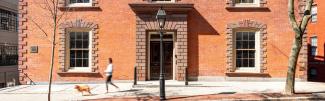
Welcome
The Rhode Island Historical Preservation & Heritage Commission (HPHC) is the state agency dedicated to safeguarding and celebrating the places Rhode Islanders care about statewide.
HPHC (aka the State Historic Preservation Office) serves as a regulatory body, research team, advisor to residents and businesses, and convener of important conversations. We work with anyone who is curious about the buildings, historic sites, cultural landscapes, and intangible heritage that make Lil' Rhody distinct.
From Adamsville to Westerly, the state is bursting with historic places, and we're Rhode Island's history & heritage people.


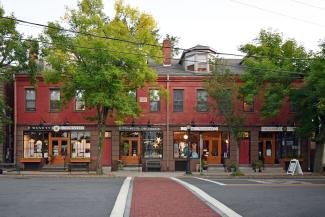
National Register Nominations in Progress
Nominating and listing properties in the National Register of Historic Places is a multi-step process, culminating in approval by the National Park Service. Here we highlight just a few Rhode Island projects in the pipeline.
The National Register of Historic Places is the federal government’s official list of properties that are significant in American history and worthy of preservation. Rhode Island has more than 17,500 National Register-listed properties (and counting!), including factory villages, diners, archaeological resources, monuments, colonial farms, pleasure boats, Indigenous sites, and suburban neighborhoods.
If you are interested in learning more about what makes a property eligible, or want to begin the process for a property you care about, start here.

Eagle Steam Mill
The Eagle Steam Mill-Harrison Steam Mill-Providence Combing Company Plant is in a densely developed industrial area of the Olneyville neighborhood of Providence. The mill building itself is made up of several parts build between 1829 and 1948, documenting the evolution of textile manufacturing in Rhode Island. In recent years, it's been used for light manufacturing and artists' lofts.
In 2002, Eagle Steam Mill was included in Providence's new Industrial and Commercial Buildings District, a discontinuous local historic district comprised of 19th and 20th-century industrial and commercial buildings.

Copley Chambers
Copley Chambers, also known as the Copley Plaza Hotel, is a good example of an early 20th-century downtown rooming house in Providence. Rooming houses provided affordable short-term housing for Providence’s growing population, offering small, shared-bath rooms within easy walking distance of the mills and downtown.
After a long vacancy, Copley Chambers has been rehabilitated into 27 small apartments for young adults transitioning out of foster care.

ILZRO House
ILZRO House in Foster is a modernist prototype completed by RISD students and faculty in the 1970s. Professor Marc Harrison was an industrial designer, educator, and a pioneer of the philosophy of Universal Design, creating products that are easier for all people to use, disabled or not. ILZRO House was an opportunity to put those ideas into practice.
This is the first project in the history of the NPS Underrepresented Communities grant program to represent the history of Americans with disabilities, “the largest minority in the United States."